Background History of Got Matar.
Got Matar, meaning "Bare Hilltop" is an area of dispersed rural settlement in the Sub County of Bondo in Siaya County
in the west of Kenya, near Lake Victoria, the source of the river Nile. Its economy is based on fishing in the Lake and
on small –scale farming which is susceptible to periodic droughts.
The area is amongst the poorest in Kenya and suffered the highest level of HIV infection in all of Kenya around the turn
of a century. AIDS killed many of the community’s working age population and left over one third of the children living as
orphans. The economic problems facing the area had been exacerbated by a very high incidence of HIV infection,triggered in
part by the cultural traditions of the dominant Luo population. The custom of “wife inheritance” offers avaluable form of
insurance to bereaved widows in normal times but can be lethal when HIV appears on the scene.
In the above respect local community leaders under the leadership of Grace Ochieng' Andiki came up with the idea of forming
Got Matar Community Development Group (GMCDG) in 2006 now a CBO to respond to the crisis. Following a series of consultation
with potential donors, GMCDG began its operations with its main objective being, to ensure that school going age children in
East Yimbo location access both Primary and Secondary Education plus skills training. See
Got Matar Institute of Technology (IoT) was founded by the Got Matar Community Developement Group in 2012 as a community
enterprise to enable young members of the community to acquire practical skills for which there was a growing demand in Kenya.
It began with a dress-making and tailor course for about 30 students in the recently built Women's Centre.Since then it has
grown rapidly and now registered, accredited and regulated by Technical and Vocational Education Training (TVET).
Learning by Doing, Succeeding for Life.
To provide quality, competency-based technical and vocational education through innovative teaching, practical skills training, industry partnerships, and character development, empowering learners with the knowledge, skills, and values needed for employment, entrepreneurship, lifelong learning, and sustainable socio-economic development.**
Inspiring Excellence, Shaping Tomorrow.
To be a leading Technical and Vocational Education and Training (TVET) institution, recognized for excellence in skills development, innovation, and producing competent, ethical, and globally competitive graduates who transform society through knowledge, entrepreneurship, and sustainable development.**
Milestones
Building Technology Workshop
Construction ran 20 March 2016 – 31 September 2017.
Clothing & Textile Centre
Construction ran 22 June 2017 – 31 February 2018.
Hairdressing & Beauty Therapy Centre
Construction ran 26 May 2018 – 31 December 2018.
Food & Beverage Workshop & Restaurant
Construction ran 20 August 2018 – 2 March 2021.
Mechanic Workshop
Construction ran 31 September 2019 – 31 March 2020.
Girls’ Hostel, Phase 1–3
Construction ran 11 March 2021 – 31 July 2023.
ICT Centre
Construction ran 21 May 2021 – 31 September 2021.
Welding & Fabrication Workshop
Construction ran 10 March 2022 – 31 September 2022.
Plumbers Training Workshop
Construction ran 1 July 2023 – 31 February 2024.
Electricians Workshop
Construction ran 1 July 2023 – 31 March 2024.
Eva Clayton Hall
Construction began 18 September 2024. Finishing work is currently in progress.
Institute Administration
Mrs. Grace Andiki
GMIT DirectorMr. Samwel Obalah
GMIT Manager
Mr. Alex Juma
Monitoring & Evaluation OfficerMiss. Phocy Aumah
Finance ManagerMr. Nicholas Arwa
IT ManagerOn campus
Central Library
Condusive environment for study and research.
Workshops & Labs
Department-run fabrication, electronics, and structures labs, open for project work outside class hours.
Hostels
Separate blocks for men and women, each with a resident warden.
Sports Ground
A full-size ground.
Got Matar Community Development Group
GMIT exists because GMCDG built it. The community group that founded the institute in 2012 remains its parent organisation today.
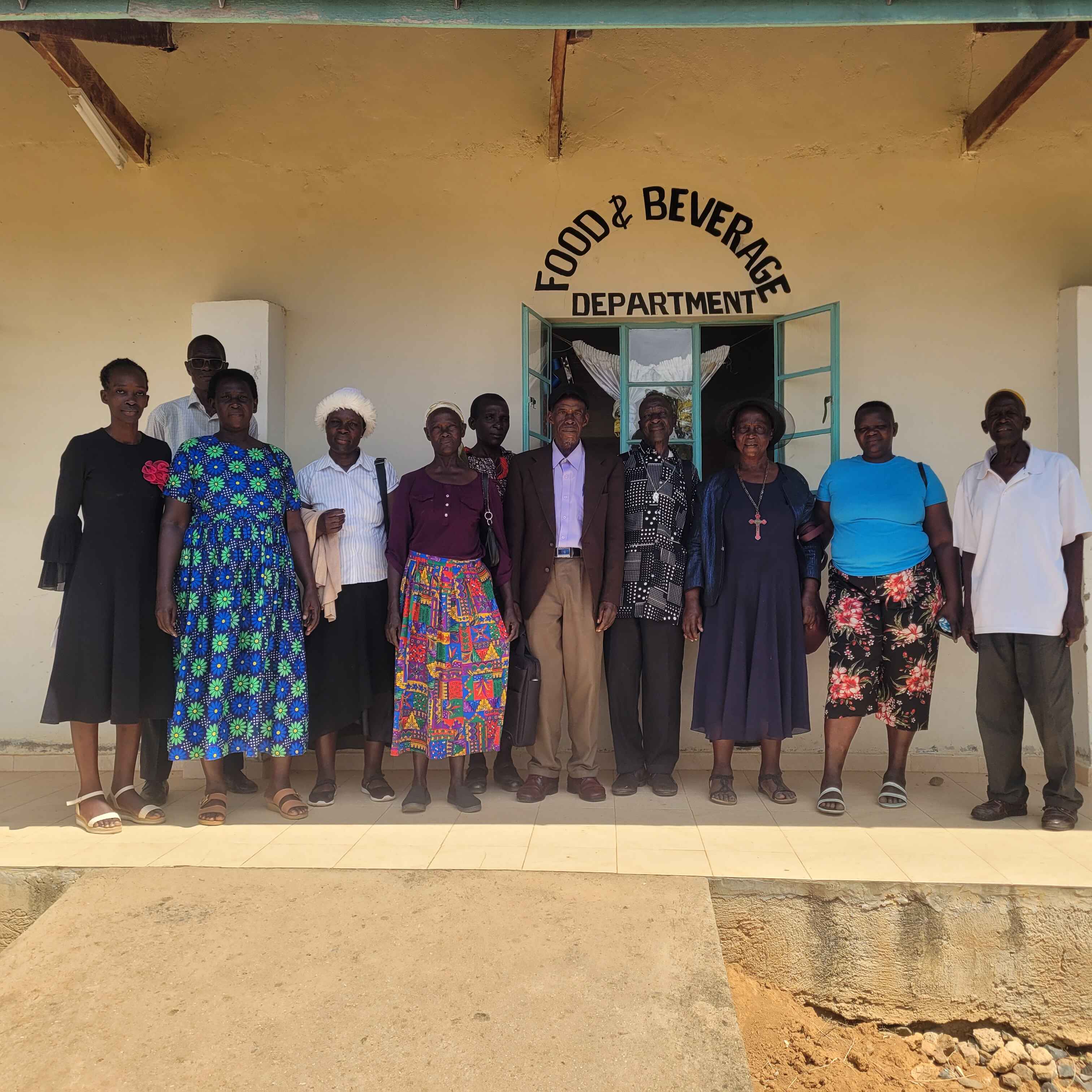
Got Matar Community Development Group, pictured outside the Food & Beverage Department.
GMCDG was formed in 2006 under the leadership of Grace Ochieng' Andiki, in response to the high orphan rate and economic hardship the East Yimbo area faced from the HIV crisis at the turn of the century. The group's founding objective was to ensure school-going children in the area could access primary and secondary education, plus skills training — the same mission that led it to establish GMIT in 2012. More on GMCDG's wider work is at gotmatar.org.